

Cell sizes have their own page: 18650 vs 21700 vs AA. This page is about fuel: whether your light takes a removable cell, how you charge it, how you store it, and what to fall back on when the grid is down. A flashlight with a dead cell is just a stick.
As an Amazon Associate I earn from qualifying purchases. Some links are affiliate links. You pay the same. Charging and storage facts come from Battery University and the makers’ own pages, named inline. This is a first look from manufacturer specs, not a lab test.
Removable Li-ion vs. sealed
If the tube unscrews and a standard 18650 or 21700 comes out, you can carry a charged spare and swap it in ten seconds. If the light is sealed, your only backup is a power bank, and the light is out of service while it charges. A sealed 140 mAh wearable like the Sofirn SE1 PRO is fine on a keyring you plug in every week. As your only house light, it’s no good.
- Removable standard cell: Wurkkos FC11C (18650), Fenix PD36R Pro, Wurkkos HD02 PRO, Acebeam H18 (21700).
- Removable but odd-size: the ThruNite Archer 2A C’s 141000 cell (14.5 × 99.5 mm, 1600 mAh per ThruNite). It’s not an 18650, so a spare has to come from ThruNite.
- Sealed: most keychain and wearable lights.
The full sealed vs. removable argument: Best Rechargeable Flashlights.
Why a dedicated charger beats USB-only
USB-C on the light is handy. It charges one cell, in that one light, and you can’t use the light until it’s done. Fenix’s own charging notes say the PD36R Pro “is unavailable while charging,” at about 3 hours per fill. A bay charger charges the spare while the light keeps working. It also charges a cell from a light with no port at all, and it can fill several cells overnight.
Battery University’s explanation of Li-ion charging is why the charger matters. Li-ion “cannot accept overcharge.” When the cell is full, the charge current has to stop, and a continuous trickle would plate metallic lithium. The same page calls “miracle chargers” that promise extra capacity a myth. A good charger just cuts off at the right voltage and stays off. (Source: Battery University, BU-409: Charging Lithium-ion.)
What to look for in a charger
- The cell sizes you own, on the spec sheet. Don’t assume. Nitecore’s SC4 page lists dozens of Li-ion sizes, including 18650 and 26650, plus NiMH AA through D. 21700 is not in that printed list. Check your exact cell on the maker’s page before you buy.
- Chemistry handling. A Li-ion-only charger avoids any mix-up. A dual-chemistry charger (Li-ion plus NiMH) is fine if it detects the chemistry or makes you choose it. Never charge alkaline AAs in anything.
- Selectable or automatic current. A low current is gentler on small cells, and a high one is faster on a 21700. Nitecore rates the SC4 at up to 3A in a single slot and 6A total.
- Reverse-polarity and short-circuit protection. Sooner or later you’ll put a cell in backwards in the dark. Nitecore lists both protections for the SC4.
- Auto stop at full and a readout. A screen that shows voltage or charge status beats a single blinking LED.
- Independent slots, so one half-full cell doesn’t hold up the others.
Verified example: the Nitecore SC4 (official page). It has four independently controlled slots, Li-ion/IMR/LiFePO4 plus NiMH/NiCd AA–D, a 5V 2.1A USB output, reverse-polarity and short-circuit protection, a temperature monitor, and an auto stop. We haven’t checked a current price, and we haven’t tested it. For other chargers in this class (Nitecore, Xtar, and similar), check the cell list on the spec sheet the same way.
Buy real cells (the 4,000 mAh 18650 problem)
Battery University puts a typical 18650 at around 3,000 mAh, with energy cells reaching about 3.1–3.4 Ah. The 21700 lights on this site ship with 5,000–6,400 mAh cells (Wurkkos, Fenix, Acebeam). An 18650 labeled 4,000 mAh or more is almost certainly fake. If it’s labeled “9,900 mAh,” it’s fake. Buy cells from the light’s maker or a known cell brand. (Source: Battery University, BU-301a.)
Even a same-brand 21700 may not fit: Fenix says its ARB-L21-6000/6000B don’t work in the PD36R PRO, so check the light’s manual or FAQ for the exact cell model.
Spare cell vs. power bank
- Spare cell: the fastest fix. Swap it and you’re back to full light. It only works in lights that use that size, and the spare needs a charger or the light’s own port to refill.
- Power bank: charges anything with USB-C, including sealed lights and phones. It’s slow (hours, not seconds), and a light like the PD36R Pro is out of service the whole time.
- Both, if the kit has to last a multi-day outage. For a big indoor battery, that’s a different product: Best Solar Generator for Home Backup.
Storage: partial charge, no loose metal
- Partial charge for long storage. Battery University says Li-ion loses more capacity stored fully charged than at around 40% state of charge. It also notes removable Li-ion packs ship at 30%. For a cell you grab weekly, keep it full. For one that sits for months, store it partly charged and top it up before a storm.
- Cool and dry. Battery University gives 15°C (59°F) as the recommended storage temperature for most batteries. A hot glove box in July is not 15°C.
- No loose metal. Never put a loose cell in a pocket with keys or coins. Use a plastic cell case or the cell’s original box. A shorted Li-ion cell gets very hot, very fast.
- Don’t mix chemistries in one light, and don’t charge alkaline or NiMH in a Li-ion-only charger.
(Source: Battery University, BU-702: How to Store Batteries.)
Grocery AA and D when the grid is gone
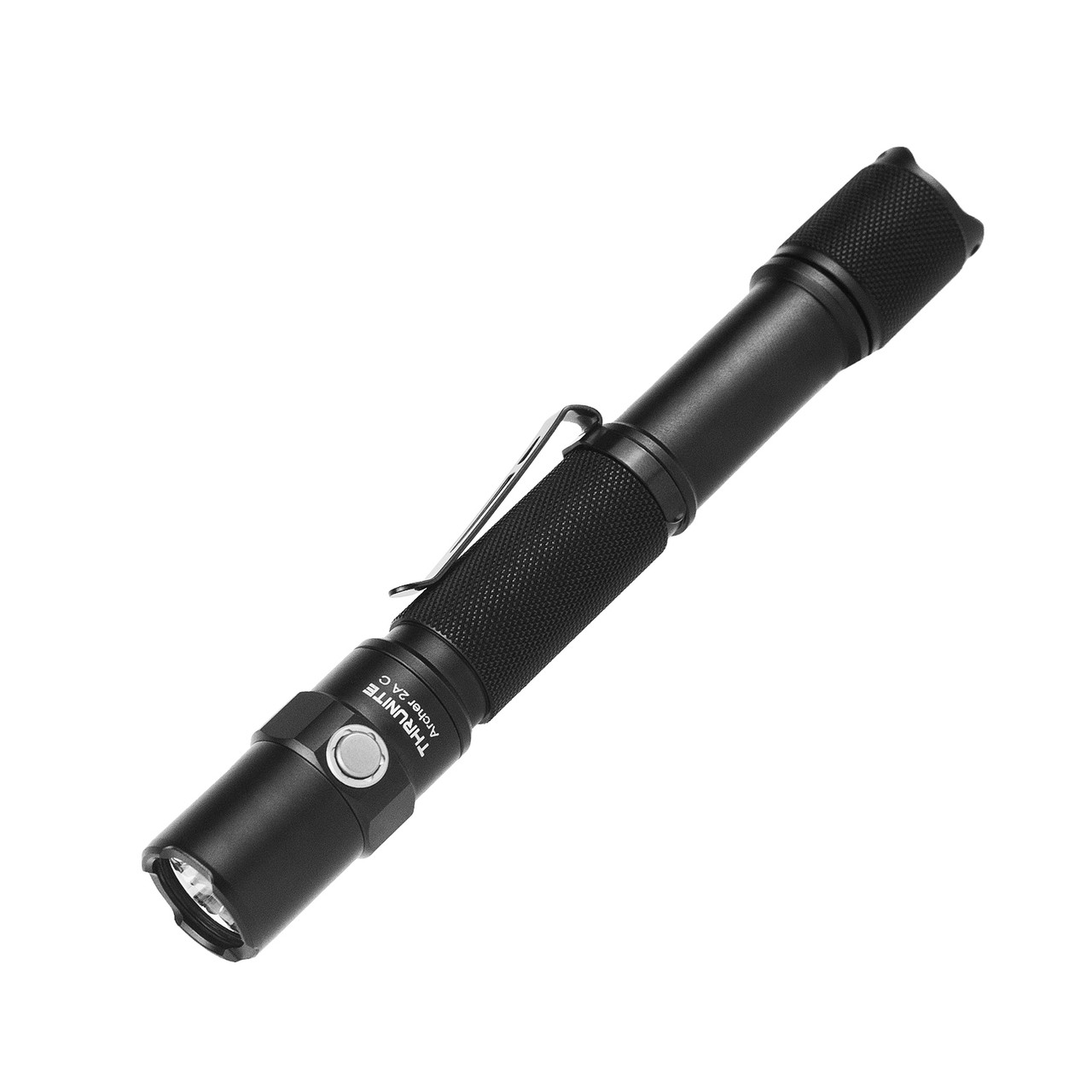
Even the best charger is useless without power to plug it into. Alkaline AA and D cells are still sold at gas stations. A dual-fuel light like the ThruNite Archer 2A C runs on its included rechargeable or on 2×AA (500 lumens / 93 m on AA, per ThruNite). A Maglite ML300LX 2D runs on two alkaline D cells and keeps working after a year in the closet. The full outage kit is here: Best Flashlight for a Power Outage.
A simple battery + charger kit
- One charged spare for each removable-cell size you own (18650 and/or 21700), from the maker or a known brand.
- One bay charger that lists those exact sizes on its spec sheet, with reverse-polarity protection and an auto stop.
- A plastic cell case for each spare. No loose cells in pockets.
- A power bank for sealed lights and phones.
- A sleeve of AAs (and D cells if you own a Maglite) for the dual-fuel or D-cell backup.
FAQ
Do I need a separate charger if my flashlight has USB-C?
Not to get started. It becomes worth it once you own a spare cell. The charger refills the spare while the light stays in use, and a light like the PD36R Pro can’t be used while it charges.
Should I store 18650s fully charged?
Not for months at a time. Battery University says Li-ion loses more capacity stored at full charge than at about 40%. For a carry spare you use often, a full charge is fine.
Can I charge AA batteries in a Li-ion charger?
Only NiMH, and only if the charger says it supports NiMH (the Nitecore SC4 does). Never charge alkaline. And never plug USB-C into a light that has an AA inside. That port is for Li-ion.
Is a 5,000 mAh 18650 real?
Treat it as fake. Battery University puts a typical 18650 at around 3,000 mAh, with energy cells reaching about 3.4 Ah. The 5,000 mAh number is real for a 21700, which is a bigger cell.
Related: 18650 vs 21700 vs AA · Best Rechargeable Flashlights · Best Flashlight for a Power Outage · Build a Complete Flashlight Kit · Flashlight Accessories
Disclosure: As an Amazon Associate I earn from qualifying purchases. Some links are affiliate links. You pay the same.